The following is a summary of further comparisons of baiting techniques for the spotted wing drosophila Drosophila suzukii. Previous posts have evaluated the use of various fruit purees and other mixes and these have determined that a mixture of one 2.5 oz packet of yeast + 4 teaspoons sugar + 12 ounces of water distributed in four or five Mason jars were very effective in monitoring and evaluating infestation levels of spotted wing drosophila.
Another test of baits was run last week. Traps (a 500 ml Nalgene bottle with 4 holes in the lid) containing one pellet torula yeast (see photo below) dissolved in 100 ml water, the yeast + water + sugar bait mixture mentioned above and finally a commercial “filth fly mix” called Yellow Muse (AgBio Corporation) allowed to cure for several weeks (the fermentation process of this material may be important) were placed November 3, evaluated November 6 and then again evaluated November 9.
The results are shown below (numbers in columns refer to average numbers of flies captured in each trap):
“Females” means that they are vinegar flies without spots on the wings and assumed to be spotted wing drosophila (SWD), while males were readily identifiable with spots on the wings.
|
Treatment |
11-06-09 SWD “females” |
11-06-09 SWD males |
11-06-09 SWD total |
11-09-09 SWD “females” |
11-09-09 SWD males |
11-09-09 SWD total |
|
Torula yeast |
2 a |
2.5 a |
4.5 a |
2.3 a |
0.5 b |
2.8 b |
|
Yeast + sugar + water |
2 a |
1 a |
3 a |
7.8 a |
24.8 a |
32.5 ab |
|
Filth fly mix |
4.5 a |
15.3 a |
19.8 a |
17.8 a |
30.3 a |
48 a |
Means followed by same letter do not significantly differ (P=.05, Student-Newman-Keuls)
From the chart above, it is apparent that the torula yeast is not very attractive to spotted wing drosophila, while yeast + sugar + water continues to be, along with well cured Yellow Muse filth fly mix, the most useful.

Dry, "torula" yeast

Packet of Yellow Muse fly bait
One of the most obvious manifestations of calcium deficiency in strawberry is “tip burn” of the rapidly growing new leaves in the center of the plant. Some varieties tend to manifest this symptom more than others.
Calcium is an important structural of component of cell walls and cell membranes in plants. A deficiency of calcium in the plant leads to a general collapse of membrane and cell wall structure, and the resulting leakage of polyphenols concludes with necrosis in the affected areas. Since there is broken down and dead tissue in these areas, microbial infection frequently results, but this is a secondary effect.
The scientific literature says that in strawberry, leaves containing less than 0.9 percent calcium are deficient, with a significant percentage of plants showing tip burn symptoms. Furthermore, calcium sufficiency is said to be in the area of 1.5% of dry leaf tissue.
Calcium deficiency in plants is not necessarily a direct result of a lack of calcium in the soil and as such might not easily be addressed simply by increasing the amount of calcium fertilizer applied. Calcium is moved from the roots to the rest of the plant via evapotranspiration by the water conducting elements of the plant, also known as the xylem. If there is a lot of evapotranspiration, such as on a hot, dry day, calcium will be moved from the roots and up through the plant. Conversely, lengthy spells of cool, humid (read fog) weather will not facilitate evapotranspiration and subsequently calcium movement can be restricted. Plant organs such as the fruit and developing leaves do not transpire as much as a fully mature, expanded leaf, and therefore would tend to be the first to express calcium deficiency.

Photo Mark Bolda, UCCE

Photo Mark Bolda, UCCE
It is a fantastic resource, well designed and very easy to navigate:
Previous posts have written about the use of chemical sprays or baits to control the recent onslaught of spotted wing drosophila, but growers should know that they have another very powerful tool in managing this pest: enhanced field sanitation.
Since spotted wing drosophila lays eggs in and develops in fruit (see photo #1 below), physical removal of the fruit from the field, either by harvest or discarding, will also remove the ability of the fly to reproduce and increase in number. Furthermore, fruit, among other things such as fungal spores and pollen, is a source of food for spotted wing drosophila. Males do not lay eggs, yet are constantly seen wandering around on fruit, and the flies are frequently seen with bodies filled with red fluid obviously extracted from fruit.
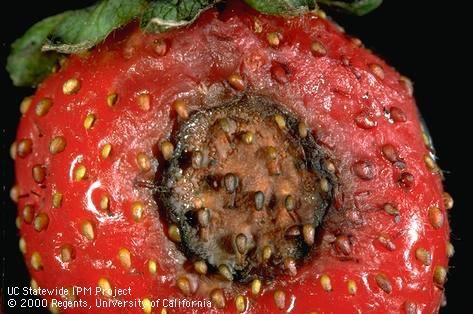
While we are not certain whether spotted wing drosophila females will oviposit on rotten fruit, we know that one, they complete their lifecycle and pupate there, and two, that spotted wing drosophila feeds quite well on rotten fruit (see photos #2 and 3 below). Therefore, removing overripe and rotten fruit fulfills two goals of fly management: removing the source of food and removing the source of reproduction.
Sanitation for strawberry growers consists of the same strategies as those used for limiting Rhizopus rot and Botrytis grey mold. Overripe and rotten fruit are removed from under the plant canopy and deposited in the furrow. Passing over the fruit with the tractor from time to time will smash it, but more importantly will foment rapid desiccation of the fruit, which is fatal to spotted wing drosophila.
Caneberry sanitation is more complicated than for strawberries simply because of the great difficult of introducing machinery into the field once harvest has begun. Up until the recent infestation of spotted wing drosophila, it has been common for pickers to deposit rotten or overripe fruit at the foot of the hedgerow (see photo # 4 below). However, this situation is very advantageous to vinegar flies, since it allows fruit to fester for long periods in the shade and high humidity of the caneberry hedgerow. The lifecycle of spotted wing drosophila is very easily completed here, as well as providing an abundance of food. A change in how raspberry and blackberry harvest is conducted which includes the removal from the field and destruction of cull fruit will result in a dramatic reduction of vinegar flies including spotted wing drosophila.

Photo courtesy Steve Tjosvold, UCCE

Photo Mark Bolda, UCCE

Photo Mark Bolda, UCCE

Photo Mark Bolda, UCCE
The following is the summary of results of a recent pesticide efficacy trial to control spotted wing drosophila (SWD) in raspberries. All materials in the test are registered for caneberries and have a one day pre-harvest interval.
Treatments:
|
Chemical |
Treatment Rate per acre |
Water Carrier Rate per acre |
|
Mustang rotated with Malathion |
4 fl oz rotated with 64 oz |
179 gallons |
|
Malathion |
64 fl oz |
179 gallons |
|
Entrust |
2 oz |
179 gallons |
|
Pyganic |
64 fl oz |
179 gallons |
|
Untreated Control |
- |
- |
First mix of materials was made with the addition of 32 oz/A LI700 acidificant.
First application was made on August 19, 2009 with gasoline powered backpack sprayers in 1173 sq ft plots inside of tunnels. Second application of malathion was made to the first treatment begun with Mustang on August 24. The gallonage of water carrier was very much sufficient to achieve full coverage of the approximately six foot high raspberry hedgerow.
Sampling for SWD was done as per the “sweep net method” in which a not to be resampled 20 foot section of hedgerow is agitated with a stick and flies collected by insect net. This method avoids tearing and soiling of the net, breaking canes and laterals, while collecting a good portion of the flies residing in the hedgerow. Most samples resulted in male SWD (distinguishable by the single large spot on the back of each wing) being a large proportion of the sample, in most cases at least half, so the assumption is that the other half were female SWD. While the chart below uses total numbers of vinegar flies collected, males and what were assumed to be females (but could in fact be regular vinegar flies since they were not sexed) were counted separately for later reference if necessary.
|
Treatment |
Preapplication |
Post 1 day |
Post 5 days |
Post 10 days |
Post 14 days |
|
Mustang rot with Malathion |
75.67 a |
10.67 c |
5.00 b |
1.00 b |
11.00 a |
|
Entrust |
69.00 a |
38.33 c |
77.33 a |
44.67 a |
39.33 ab |
|
Untreated control |
68.33 a |
142.33 a |
130.67 a |
46.33 a |
128.67 a |
|
Pyganic |
65.00 a |
76.33 b |
86.67 a |
63.33 a |
80.00 ab |
|
Malathion |
45.00 a |
11.67 c |
14.33 b |
1.33 b |
7.33 b |
Means followed by the same letter do not significantly differ (P=0.05, Student-Newman Keuls)
The organically registered Pyganic and Entrust have efficacy over the short term, but the conventional materials show efficacy out to two weeks post application and offer a good solution to a serious outbreak of large numbers of SWD.
Additionally, three registered horticultural oils, Azadirect, Organicide and Ecotrol were tested in non-replicated fashion in the same area as the trial above. None offered any control of significance, however.
The collaborating grower applied Diazinon 50W to raspberries of discontinued harvest at the maximum rate of 2 lbs per acre to devastating result. While having similar levels of flies than the untreated check in the study before application, there were very few flies left after with many samples coming up zero, and this continued to be the case a week after.
There are several important topics to discuss concerning the results of these chemical efficacy trials.
Resistance: With such outstanding results as those above, it is easy to decide that one will go with one of the cheaper chemistries and continue until the flies are all gone. While this sentiment is understandable, it is imperative that pesticide users rotate the chemicals they are applying. Since one is pitting the chemical against what is quite likely several million flies per acre and the subsequent genetic diversity such a large number offers, the likelihood of the pest population becoming resistant and not controllable after continued use of the same chemical application after application is very high. History with other pests tells us that it can take only a few years to reach complete resistance. Rotate.
Effects on Non-target Species: Malathion and Mustang are broad spectrum pesticides, meaning along with killing flies they will kill most beneficial insects such as predators and parasitoids. While for the time being, these chemicals are providing a solution to a critical acute situation, over the long term other solutions integrating other methods (more in continuing posts, enhanced sanitation comes to mind first and foremost) will have to be sought. Although one may tend to think that the high numbers of SWD indicate that there is very little biological control going on, remember that SWD is only recently established here so it may take several years for native predator and parasite populations to adjust to this new and large source of food. The high densities of this fly in one place are just begging for disease outbreaks. One expert with experience with insect invasions in California predicts with a high level of confidence that the large numbers of SWD currently experienced will be much lower in two to three years because of natural control.
Raspberry and blackberry growers who use bees for pollination must be aware of what pesticides will do to foraging bees. Malathion and Mustang are unquestionably toxic to bees, Entrust less so once it has dried. Pyganic, while less toxic than the others, still requires some precautions. It is best not to apply at all when plants are flowering, and generally this period of time will not have many vinegar flies present anyway, since they are drawn to ripening fruit rather than flowers.
The following link by Pacific Northwest Extension is very useful and includes a pesticide safety chart when referring to pesticides and honey bees:
http://extension.oregonstate.edu/catalog/pdf/pnw/pnw591.pdf
There are several insecticides mentioned for control of vinegar flies in this article. Before using any insecticides, check with your local Agricultural Commissioner's Office and consult product labels for current status of product registration, restrictions, and use information.