
- Author: Kathy Keatley Garvey
Show me the honey? Show me the California Honey Festival.
The annual event, which emphasizes the importance of bees, and promotes honey and honey bees and their products, will take place from 10 a.m. to 7 p.m., Saturday, May 4 in downtown Woodland.
It's free and family friendly. It traditionally draws a crowd of some 40,000.
Amina Harris, who retired last June as director of the UC Davis Honey and Pollination Center, co-founded the honey festival in 2017 with the City of Woodland. She actually "retired" to the family business, Z Food Specialty and The HIVE, Woodland, where her title is "Queen bee."
The California Honey Festival continues to partner with the Honey and Pollination Center in presenting the festival.
The organizers promise "something for everyone." You can expect honey tastings, bee observation hives, kids' activities, cooking demonstrations, live music, vendors and much more. The UC Davis-based California Master Beekeeper Program, which uses science-base information to educate stewards and ambassadors for honey bees and beekeeping, will not be participating this year. But science-based information on bees will be provided by the California State Beekeepers Association and the Sacramento Area Beekeepers' Association.
Ask them questions! And remember you can sign up for classes with the California Master Beekeeper Program (CAMPB), founded (2016) and directed by Elina Lastro Niño, associate professor of UC Cooperative Extension, apiculture. She is a member of the faculty of the Department of Entomology and Nematology. As the CAMPB website indicates: The organization is "a continuous train-the-trainer effort. The CAMBP's vision is to certify Honey Bee Ambassador, Apprentice, Journey, and Master level beekeepers so they can effectively communicate the importance of honey bees and other pollinators within their communities, serve as mentors for other beekeepers, and become the informational conduit between the beekeeping communities throughout the state and UCCE staff. Explore the Certifications Page for more information."


- Author: Kathy Keatley Garvey

Give them a 21-insect net salute.
That's what occurred at a recent retirement celebration honoring the legacy of UC Davis distinguished professor emerita Lynn Kimsey, director of the Bohart Museum of Entomology for 34 years.
Kimsey, who joined the UC Davis Department of Entomology (now the Department of Entomology and Nematology) in 1989, became the director of the Bohart Museum in 1990.
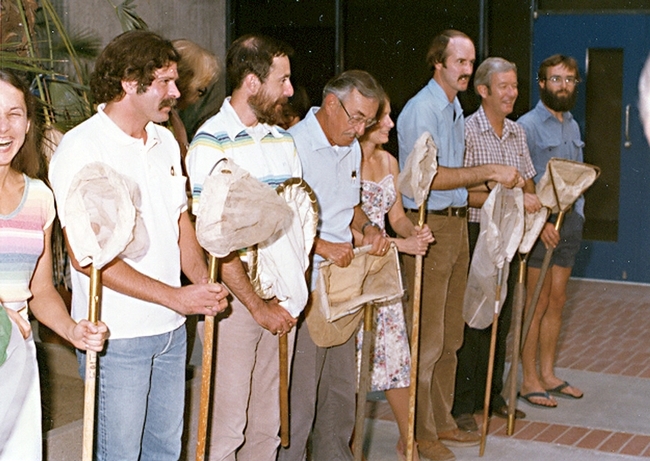
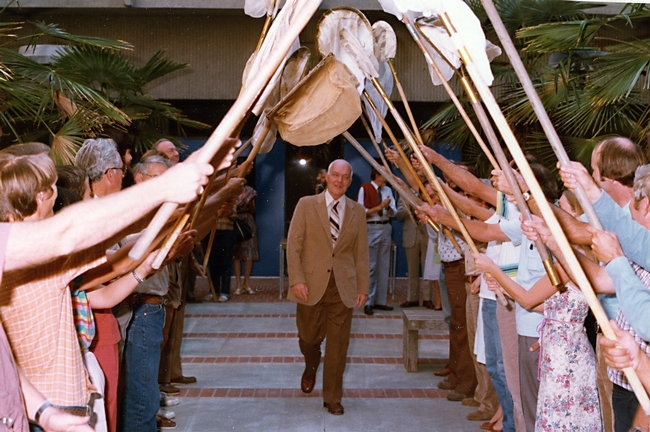
Noted entomologist Richard "Doc" Bohart (1913-2007) founded the insect museum in 1946. UC Davis Chancellor James Meyer (1922-2002) dedicated the facility in 1986 as "the Bohart Museum of Entomology" at a ceremony in Briggs Hall. A highlight: Faculty, postdoctoral fellows, graduate students and others saluted him with a 21-insect net salute. They lined up, formed an archway with their nets, and Professor Bohart walked under the archway.
Kimsey, who was Bohart's last graduate student, recalled that event "as one of the funniest memories" of her career when she delivered a speech last November at the Davis College of Agricultural and Environmental Sciences (CA&ES) event honoring recipients of its excellence awards. Kimsey received the Exceptional Faculty Award.
Kimsey retired on Feb. 1, 2024 (but she's still doing research and continues to be the executive director of the Bohart Museum Society and the writer-editor-publisher of the quarterly Bohart newsletter.)
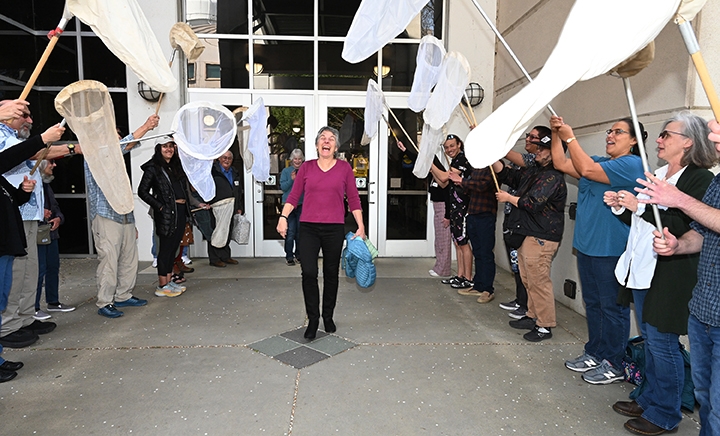
Then came the retirement celebration on April 6. Her colleagues, collaborators, faculty, staff and students gathered in a Mathematics Building classroom on Crocker Lane for speeches, and then headed over to the nearby Bohart Museum for the 21-insect net salute, a buffet and more tributes.
As Kimsey walked beneath the archway of the 21-insect net salute leading into the Bohart Museum, a chorus of cheers and applause greeted her.
She always remember that.
Just as she remembers the first insect net she received at age 5.
“I've always been interested in insects," Kimsey said. "I got my first insect net at age 5.” A portrait of her holding that net graces the Bohart Museum.
Under Kimsey's direction, the Bohart Museum that "Doc" Bohart founded 78 years ago expanded from 400 specimens to some eight million insect specimens today. It is the seventh largest insect collection in North America.
A recognized authority on biodiversity, systematics and biogeography of parasitic wasps, urban entomology, civil forensic entomology, and arthropod-related industrial hygiene, Kimsey holds two entomology degrees from UC Davis: a bachelor's degree (1976) and a doctorate (1979). "I got to pursue my bug interests," she said. "I know it was kind of weird, but even as a little kid it was fun."
It still is, Kimsey told the crowd at her retirement celebration.
The new Bohart Museum director is arachnologist and Professor Jason Bond, the Evert and Marion Schlinger Endowed Chair in the Department of Entomology and Nematology and associate dean, College of Environmental Sciences (CA&ES).
Resources:
- Access the UC Davis Entomology and Nematology website for the retirement celebration story.
- Listen to Kimsey's speech recorded by Walter Leal, UC Davis distinguished professor of molecular and cell biology and former chair of the Department of Entomology. It is posted on X (formerly Twitter) at https://x.com/wsleal2014/status/1776732932901863666)