
Reaching youth with a healthy lifestyle message is vital. A healthy lifestyle incorporates proper eating, physical activity AND gardening. Educating youth about a healthy lifestyle is especially critical today: nearly one in three U.S. youth are obese. Using youth to reach youth with the healthy lifestyle message is essential to its success. Thankfully, there is an organization that is trying to do this in a big way.
Recently, I had the opportunity to travel to Kansas City, Missouri with my daughter, Natalie, so that she could participate in a special meeting. The opportunity was offered by the Alliance for a Healthier Generation, which is a collaboration between the William J. Clinton Foundation and the American Heart Association. The Alliance has recently selected twenty youth between the ages of 8 and 17 to serve as its youth advisory board, and to act as spokespersons for the issue of childhood obesity. The youth are from all across the nation, and have diverse interests, talents, life stories and goals. But they share one ambition: to help all youth lead a healthier lifestyle. They gathered in nearly the literal center of the nation - Kansas City, Missouri - to tackle one of the most serious issues facing youth: obesity.*
When we arrived in Kansas City after a long day of travel, we didn't know what to expect. We went down to the pool to meet the youth and their parents. Within minutes, the kids were friends. Since they've left Kansas City, they have been in constant contact via email, text messaging, phone and Facebook, sharing ideas, resources and energy. Each is commited to making a difference in their community. Together, they hope to make a difference nationally. After meeting them, I believe they will. They are already spreading out, like so many seeds tossed in the wind. Some are interviewing with newspapers. Some, like my daughter, have started blogging about healthy lifestyle issues. Others are speaking in public venues, getting youth to sign healthy lifestyle pledge cards, hosting community events to raise awareness of the issue...they are using their passion and creativity to reverse the tide of childhood obesity that threatens to overwhelm our nation's health system.
Their goals are ambitious: to stop the climb in childhood obesity by 2010, and to reverse the trend by 2015. Laudable goals. Amazing youth. I will watch their efforts with great anticipation. You can, too, by visiting the Alliance's website.
So what's the gardening link? Gardening provides a way to improve diet and is a form of healthy exercise. It's a great kid-friendly activity, too. Gardening is a vital part of a healthy
Continue ReadingRemember that song??? I remember it well. Its lyrics inspired thousands of people to come to San Francisco. Written by the Mamas and Papas John Phillips, and recorded by Scott McKenzie, the song quickly became a cultural icon.
At age 7, I was too young to travel to San Francisco during the summer of 1967. I won't miss my opportunity this time, though, and will be joining thousands of other like-minded people over Labor Day Weekend 2008 for what promises to be an amazing series of events and activities sponsored by Slow Food Nation. "Come to the Table" invites all of us to travel to San Francisco, to recognize our collective strength, to learn more about sustainable food systems, real food, and to celebrate together.
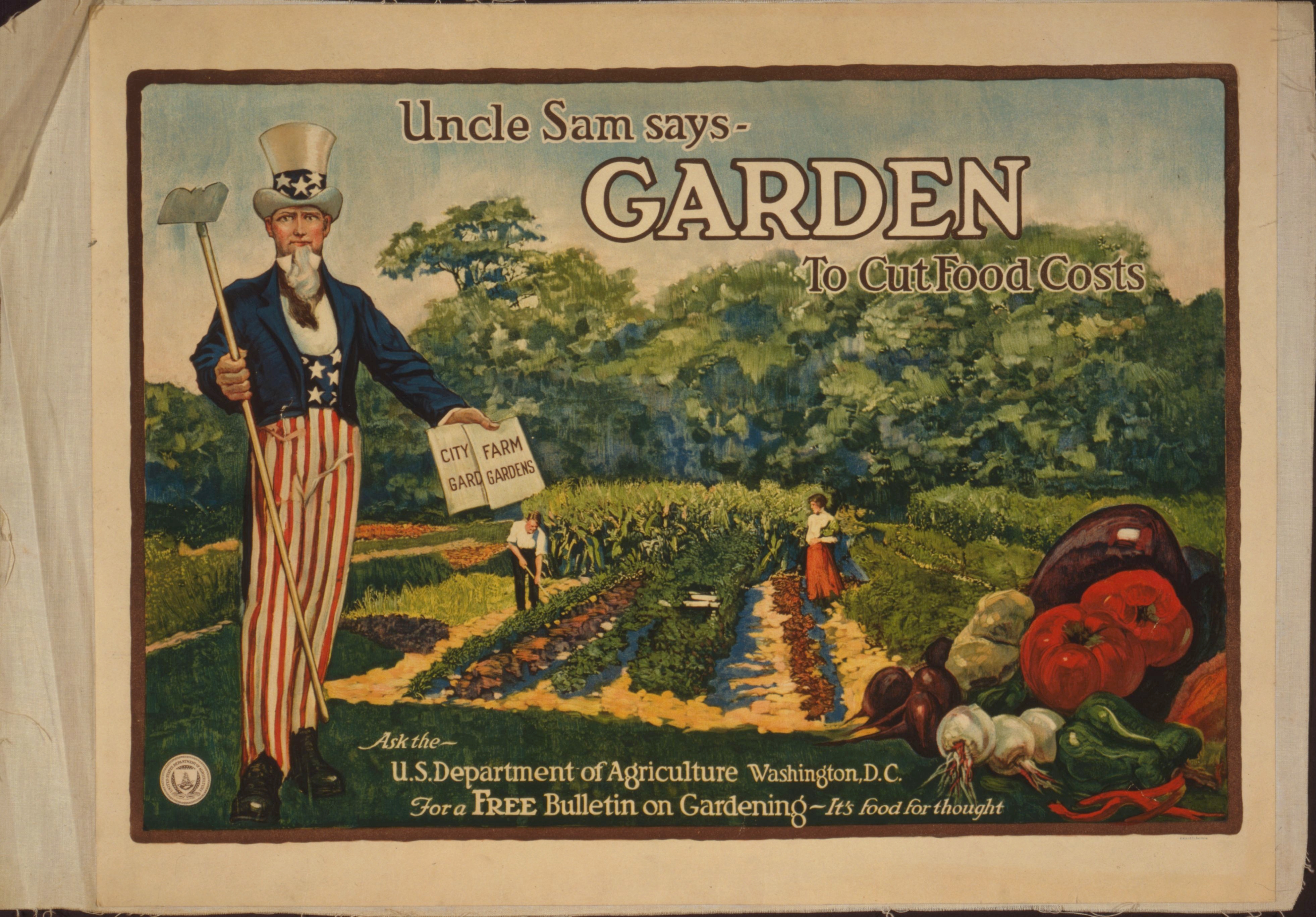
Top on my list will be a visit to the San Francisco Victory Garden at the Civic Center. In World War I and World War II, the Civic Center was home to Victory Gardens. San Francisco had extraordinarily robust wartime gardening programs, and celebrated the success and importance of this work through a series of public activities. It says a lot about the City of San Francisco that it is once again claiming civic space for such an important activity.
We can learn some important things from our past about the use of civic space for gardening. In WWI, Edith Wilson (President Wilson's second wife) grazed sheep on the White House lawn, doing her "bit" for the war effort. Eleanor Roosevelt planted a vegetable garden on the White House lawn during WWII. Photographs of Vice President Henry Wallace working in his Victory Garden, sometimes with his son, were distributed to the Press Corps during WWII. Gardens were planted in public spaces throughout the nation: parks, schools, and city-owned lots. Gardens were planted at homes, on median strips, on military bases and at workplaces...wherever Americans lived, worked, gathered, prayed for the war's end, and hoped for a brighter, more peaceful future.
In WWI and WWII, gardening claimed not only important physical space in American life, but an important place in the American psyche. Gardening was a vital expression of American civic life, bridging ethnic, socioeconomic and class differences. It was an activity to which we could devote our considerable energies without reservation. An activity that united us in hard and uncertain times.
If you're going to San Francisco, this summer, be ready to celebrate Victory Gardens, an old idea that is coming around again. Be ready to learn a lot about America's food system. Be ready to meet other people who share your dreams, your values, and who are ready for a food revolution. If you're going to San Francisco, be sure to wear
Continue ReadingThe Verde Partnership Garden is located on the campus of Verde Elementary School in North Richmond. It is a true partnership: both a school and community garden project. It's one of the loveliest gardens I've ever seen.
The project's coordinator is Cassie Scott. A gentle and wise woman, she shared some of the garden's history with me.
The Verde Partnership Garden project serves an extremely low income North Richmond neighborhood that despite its poverty, is rich in diversity and a sense of community. Like many urban areas in America today, North Richmond is poor. Per some statistics, ninety-seven percent of North Richmond families are eligible for public assistance, and the average family income is below $21,000 per year.
More than a decade ago, the area where the market garden now resides was a trash-strewn field behind the school. Richmond has a large population of Laotian refugees. A number of those Laotian refugee mothers - many formerly subsistence farmers from the Mien group - appeared one day and began quietly working. They sought no public permit. They saw a need, and they filled it.
Within three days, these women had claimed unloved and unused public space in the center of their community - the school where their children attended - and turned that space into 25 family garden plots. They hand-tilled each one, and in so doing, transformed a school. One of the school's employees, a child therapy intern with a background in organic gardening, was inspired by their work, and in the adjacent area, cultivated a small children's garden. Several organizations also became involved in the effort, including Catholic Charities. So began the Verde Partnership Garden.
This garden grows healthy children along with healthy food. It serves the school as an outdoor laboratory that brings classroom learning to life. It has distinct areas that encourage nature study and human interaction. Using the garden as its center, teachers and community volunteers teach cooking, nutrition, job readiness, literacy and leadership classes. The garden is a wonderland for children, providing areas of exploration, study, and contemplation.
The original field portion cultivated by a generation of immigrants eager to put down literal (and figurative) roots in the community, has now become a production-oriented garden, a student-run business. It provides food for the community, rolling into the larger effort of the 5% Local Coalition's work to produce and consume 5% of Richmond's food locally. It demonstrates the potential of urban agriculture to produce meaningful quanitities of food for local communities.
The garden may be helping Verde Elementary School in other important ways. The school placed last in statewide acade
Continue ReadingI have not blogged much the last two weeks, perhaps because I've been caught up in thought and possibility. Two weeks ago, I had an opportunity to travel to Richmond, California to visit a number of school and community gardens. I met with residents, and learned about the remarkable work of organizations such as the National Park Service, Urban Tilth, and the 5% Local Coalition in this city in west Contra Costa County, east of San Francisco.
My hosts, Park Guthrie of Urban Tilth, and Carla Koop of the National Park Service's Rosie the Riveter/World War II Homefront site, organized an amazing (and amazingly busy!) two day visit. (You'll hear more about Park and Carla and others I met in future blog postings). The visit ended up being one of the most profound professional and personal experiences I've ever had.
A vibrant shipbuilding city on the American WWII homefront, Richmond faces new kinds of challenges in this new American homefront. The community has experienced serious violence and poverty (some statistics indicate that more than 1 in 5 of Richmond residents under the age of 18 live below the poverty line, but I'm guessing with the current economic situation which is hurting so many Americans, that the figure is higher). There is a lack of employment opportunities, and some degree of blight as industries have left the area. Several residents told me about the negative press their community always seems to garner in the media. North Richmond and the Iron Triangle have certain connotations. The pain of some of the people I met about the negative portrayal of their community in the press was obvious. Richmond is much more than negative statistics.
I saw a different Richmond than the one that is often presented in the media. I saw a Richmond that is trying to create a new statistic that should inspire us all: producing and consuming 5% of the city's food locally.
I saw many other amazing things falling out of this work: community building, positive youth development, pride, healing, collaboration between people of diverse backgrounds and with diverse interests...what I saw is that gardens are creating all sorts of new possibilities in this community, helping to create a new American homefront that could serve as a model to us all.
My first stop was to visit three adjacent and linked sites: the Lincoln School Farm, Berryland and the Richmond Greenway.
At the Lincoln School Farm, I learned about a wonderful after school program that engages children through gardening. The number of participants varies on given days, but most weeks, students go home with fresh produce from the garden spaces they tend.
Berryland is an unfenced and openl
Continue ReadingI've written a bit about gardening as an important part of civic engagement in American life. Not only in the past, as reflected in Victory Garden programs, but in contemporary American society. Programs such as The Food Project in Boston engage youth through gardening/urban agriculture, providing not only practical skills, but valuable life skills, as well. These kinds of efforts engage youth in creating a food future that is sustainable, healthy and just.
I call this "coming back out onto the front porch."
When I was a small child growing up in a bucolic community outside of Philadelphia, the return of warm weather each spring brought the screen door out from winter storage. The front door remained open nearly all summer, even late into the evening. The front porch was a favorite gathering spot. There, the business of the neighborhood, whether negotiating playdates, exchanging pleasantries or courting (I had older siblings) was transacted.
Each Fourth of July, our front porch became the staging ground for our family's participation in the neighborhood parade. In retrospect, it was a pretty simple thing: bikes, wagons and all the kinds of contraptions kids could create, decorated in red, white and blue. When I was five, I led the procession down our block, wearing a tall Uncle Sam hat. The day seemed to last forever, with lots of good food shared among neighbors (including tomatoes from our garden, salted watermelon, and incredibly sweet berries). Everyone came out onto their front porch to participate in the collective life of our block.
Two weeks ago, our CSA piloted delivery of our midtown Ventura produce boxes to my front porch. It was a great trial run. Two of the families to whom boxes were directed are close friends. The mother of the third family works at my daughter's school, and I know her. One box was to be claimed by a woman who is a friend of a friend. The other boxes were destined for individuals I had not previously met.
We left the front door open, and throughout the course of the late afternoon and into the evening, people dropped by to pick up the boxes. It was nice to say "hello," talk about the great food we had received, and just re-connect. Natalie and I stepped out onto the front porch into "deep community," where we shared with neighbors and new friends our intentional decision to participate in a different kind of consumption pattern.
Contents of our box included farm-fresh eggs, fresh-baked bread, lucious blackberries, fennel, carrots, potatoes, cherries, apricots, lettuce, squash, and the largest onions I've ever seen. Good stuff all. An extra box was left for sharing with neighbors and friends, and
Continue Reading