


- Author: Rose Hayden-Smith
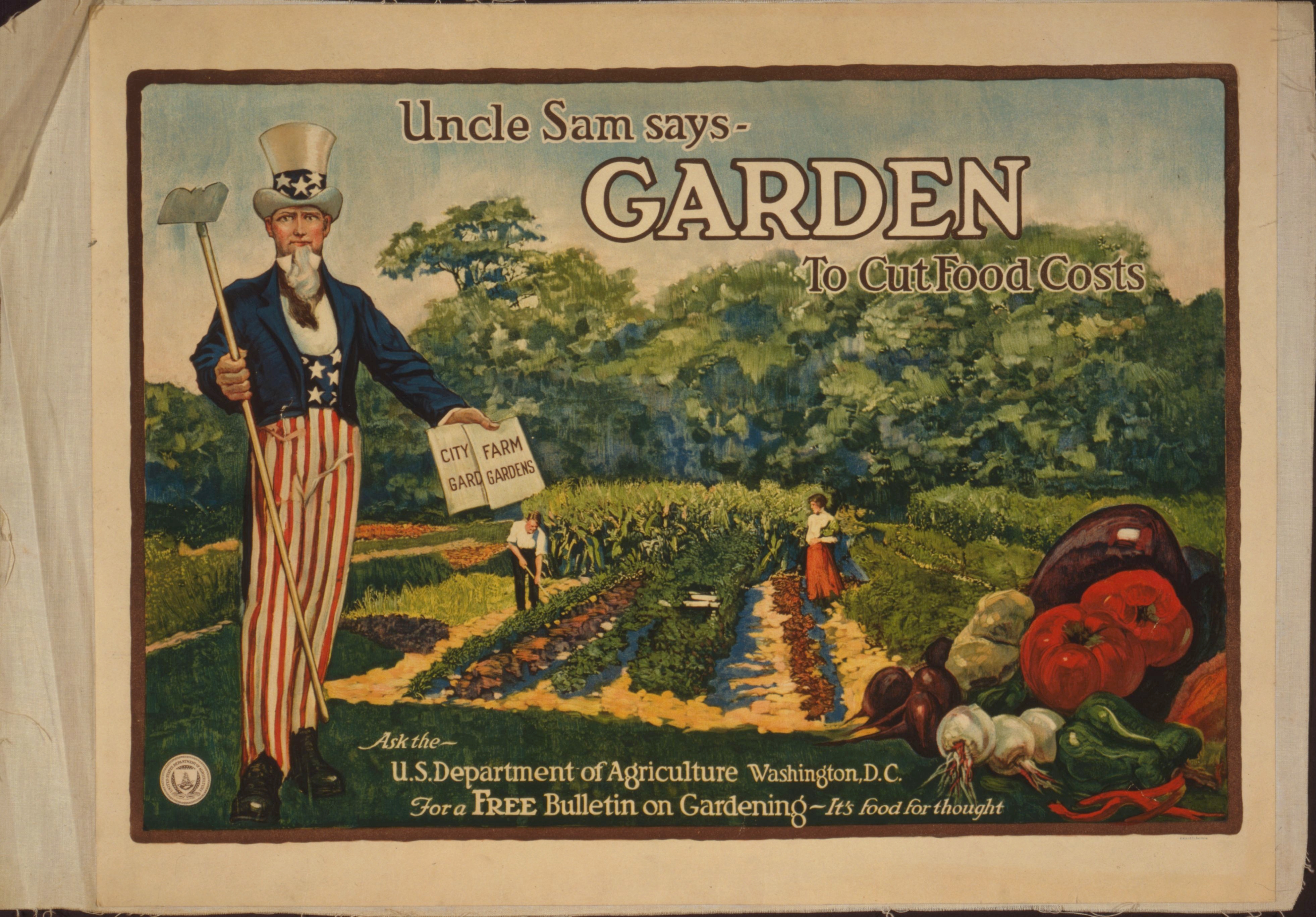
An entire chapter of my book, “Sowing the Seeds of Victory: American Gardening Programs of World War 1” is dedicated to WWI poster art and propaganda. Chapter Four contains numerous poster images and a detailed analysis of each. One of my favorite images is this one – Uncle Sam Says Garden” - produced by the USDA.
“Uncle Sam Says Garden” was a poster that was directed to wider audiences than some of the other gardening posters, which were directed to children. Produced in 1917, it shows Uncle Sam in the foreground, holding a hoe in one hand, and papers that read “City Gardens” and “Farm Gardens” in the other. These words are clearly meant to synthesize the interests of rural and urban Americans: gardening was a shared activity, a common national goal. A man and woman work in the garden shown, which is in the shape of the American flag. Some of the plants featured in the garden might appear to be stars upon the flag. The woman in the poster wears a long, red skirt and a white shirt; in her arm is something she has harvested from the garden.
A subtitle suggests that Americans might wish to garden in order to “cut food costs.” Those seeing the poster are urged to write to the USDA for a free bulletin on gardening, suggesting, “It's food for thought.” The poster is framed by brown band, and the bottom right corner features a cluster of richly hued vegetables. Upon careful inspection, the background, featuring trees, actually bears a striking resemblance to leafy green vegetables and also to broccoli stems. The use of Uncle Sam in gardening posters was not as common as Columbia, and in this depiction, he is dressed in clothing covered with stars and stripes, and has a piercing game.
This poster offers a message that is still food for thought, don't you think?
“A Garden for Everyone. Everyone in a Garden.”
Bye for now. @victorygrower

- Author: Rose Hayden-Smith
Not long ago, a friend asked several of us to jot down some memories about the kitchen tables in our lives. The operating premise of the exercise was that food is central to our relationships, and that much of life occurs around the places where we eat, and those we choose to eat with.
My kitchen table memories are varied. My family moved quite frequently when I was young: our kitchen table was a sort of “movable feast.” In my faith tradition, this term has a very specific meaning that informs my attitudes toward food. (For the very literary minded, it is also the title of a wonderful memoir written by Ernest Hemingway late in his life).
I have wonderful memories about kitchen tables. In our home near Philadelphia, I remember my older sister sitting at the table in the spacious kitchen, trying to cajole me to eat more before we went to church. I was served the best pancakes I’ve ever eaten at that very table. It was at this table where my brother once committed the serious transgression of launching scrambled eggs at my sister, using his fork as the springboard. (This happened exactly once.) A few years later, in the San Fernando Valley, close by some citrus orchards where the California State University campus now stands, I recall eating wonderful meals at our new home, which featured a formal dining room, where my parents proudly used the plastic fruit I’d bought them as a gift as the table’s centerpiece.
I remember my Grandmother Eloise’s elegantly appointed dining room table in Clinton, Miss., where we always drank heavily sugared iced tea from the tallest glasses I'd ever seen, being certain to clink the ice with long handled silver spoons. My grandmother’s was the most modern kitchen I’d ever seen, and she dressed up for every meal. Only a few miles away, in Jackson, we also took supper with my other grandparents, RJ and Pauline, at their kitchen table in a modest home on a quiet tree-lined street. These grandparents, raised in a small rural community, fed us homegrown sliced tomatoes, stewed okra, skillet cornbread, fish caught by my grandfather, and bowls of steaming hot (and spicy!) gumbo.
I also remember the dinette set in my family’s small camping trailer, where my dad prepared and fed his kids Kraft Mac & Cheese and tuna fish. (Different food generation, but great dad!) It was also the table where we played board games and cards by lantern light, watching the Firefall at Yosemite Park. After dinner, games and a soothing cup of hot chocolate, the dinette set was folded down and became the bed I slept on.
When my husband and I got our first apartment, we went to a used furniture store called Egypt's and bought a tiny bowed kitchen table. It was constructed of particleboard and covered with faux wood laminate. We used it for years. It was where we prepared our budget-wise home cooked meals every night, clipped coupons and prepared for graduate exams.
When we bought our home, we found ourselves with more space, but little cash to furnish it. While visiting a second-hand store in our tiny downtown, we fell in love with a large, heavy table. It was a little dinged up, was missing the leaves, but clearly had been loved by a large family. It featured an extra set of legs in the middle of the table, meant to support it at its grand length when fully extended. We paid what was for us a small fortune to purchase the table, and got friends to help us move it. We had no chairs, so a friend gave us three turn-of-the-(last)-century chairs salvaged from the U.S. Maritime Commission Office in Long Beach. They don't match the table or each other, but we've never cared and have kept them. They are simply marvelous.
We live in a small home, so our table serves as both kitchen and dining room table, just a foot or so from the counter and the stove. While a smaller table might make more sense, I'd never let this one go. We refinished it several years ago, and it turns out that it's quite an unusual and valuable table, worth many, many times what we paid for it.
It's certainly priceless to me, mostly because it's anchored our family in this house. As the child of movable tables and movable feasts, I've found its constant presence uniquely reassuring. It's where we prepare food and school projects and where I do much of my writing. It's where I sat my daughter and bandaged her first skinned knee. It’s where the three of us share breakfast together every morning. Where we’ve hosted birthday and holiday celebrations, team parties, teen gatherings, study groups and committee meetings (all involving good food and good people). Where we’ve had important family discussions, shared memories, and laughed. It's where my husband reads the sports page, where I fume over the editorial page, and where my daughter and I craft and sew. It's sited between two windows three feet from our side fence, where honeysuckle grows lush and fragrant, and where the poinsettia transplanted from our neighbor’s yard more than 20 years ago blooms brightly.
The kitchen table hosts ever-changing coverings. A tablecloth given to us by friends after their trip to Guatemala. Another one made by my sister, with matching napkins. An antique lace cloth I found in a small store near home. On very special occasions, we let the wood speak for itself.
I don't know the history of the table before it joined our family, but it has claimed a central place in our family's history. After we purchased this table, the table we purchased from Egypt’s was recycled to hold an ever-growing collection of plants. It finally expired a few years ago. I was sad to see it go.
Have a safe and happy summer, filled with healthy and delicious food, eaten at tables you love, with those you cherish.
Photo Credit: Natalie Smith, Foothill Technology High School

- Author: Rose Hayden-Smith
I was recently given a copy of the Prince of Wales’ speech “On the Future of Food,” offered at a conference of the same name, held at Georgetown University in Washington, D.C. in May 2011. Rodale has reproduced the speech in a small pamphlet with a foreword written by Wendell Berry, and an afterword provided by Will Allen and Eric Schlosser (all super writers and superstars in the sustainable food system movement). GRACE Communications, which helped sponsor last year’s conference, has created a website – www.ontheFutureofFood.org – to serve as a central site where individuals can learn more about the topic and this speech.
The pamphlet or tract format of this publication was intriguing to me; I immediately thought of Thomas Paine’sCommon Sense. It evoked a sense of the historical use of pamphlets in America as a means to influence political life. Its compact size and compelling message invite the reader to pass it on. (I did find it all a little dizzying in a historical sense to think of the food aspect of the relationship between America and Great Britain over the centuries: America first as a British colony with a role in providing agricultural and natural resource products to the mother ship; then America as a new nation created by a revolution of farmers – okay, farmers AND others; America providing much needed sustenance to England during World War I; and in 2011, a modern American audience hearing an important message about sustainability in food systems from a member of the British royal family. Admittedly, though, there is an enormous difference between King George III and Prince Charles).
The food system today is a highly political issue. Nearly everyone I know agrees that the future of food will require a complex and inter-related set of choices and actions, each with economic, cultural and geopolitical implications. Nearly everyone I know agrees that many of our current practices are not sustainable when considered within any number of frames (water quantity and quality, pollution, soil erosion, climate change, social justice, etc). We can no longer afford to view pieces of the food system in isolation (whether by commodity or a single geographic location). Rather, we must view the system as a whole, because the “solution” to a production problem in a certain commodity or place may create problems in other areas. Acting in concert may save us; continuing to consider food production in an isolated fashion will certainly doom some of us.
Prince Charles discusses in some detail international food insecurity, which is a very serious issue with implications for all of us. Agricultural productivity is declining, population is increasing, and the challenges on the production side are complex and growing. His Royal Highness notes that food insecurity threatens political stability in some countries. We’ve seen that in the last year in the Middle East: social unrest is about a desire for democracy, but it’s also about the cost of bread. In countries where economies are growing (such as India and China), diets are becoming more westernized (i.e., increased consumption of meat), which places additional demands on a system operating under finite resources and other constraints.
In 2008, a report called the “International Assessment of Agricultural Knowledge, Science and Technology for Development” was published. Representing collaboration among a number of groups, including the United Nations, the report concluded (among other things) that small-scale farming systems utilizing agro-ecological approaches were found to be among the most productive in what the report classified as developing nations. This finding could have implications for how the challenge of food insecurity is approached. A full copy of the report can be found at www.agassessment.org; it provides an interesting and somewhat sobering view of the state of agriculture and food systems around the world.
In general, “On the Future of Food” lays out most of what more and more people are coming to believe about the food system. It does so succinctly, summarizing a wide range of issues briefly (yet thoroughly). It provides a systems view. What is novel in the piece are Prince Charles’ statements about the true costs of food production, which he argues are not factored into the bottom line. His point? Everyone pays a higher price than the “market price,” whether it be through the costs of mitigating pollution, increased public health costs due to higher obesity rates, etc. Of no small consideration are what Prince Charles terms the “true costs to the Earth” of certain production practices. (He deems low food prices in some nations “an illusion”). He also briefly discusses a study, sponsored in part by the United Nations, entitled “The Economics of Ecosystems and Biodiversity” (TEEB), which explores the concept of natural capital. The purpose of this study in part was to “initiate the process of analyzing the global economic benefit of biological diversity, the costs of the loss of biodiversity and the failure to take protective measures versus the costs of effective conservation.” The full report can be found at www.teebweb.org.
Some have dismissed the prince’s work on sustainability issues as the dabbling of a rich royal who is removed from the concerns of real life. However, through his foundation, the prince has been engaged in the issue of sustainable communities for a quarter of a century. He has long been engaged in developing sustainable practices on the properties he owns. Since 2004, Prince Charles has also worked on an “Accounting for Sustainability Project” that provides tools for various businesses and other groups to help achieve the changes needed in corporate reporting, accounting and decision-making that will take into account natural capital (the kinds of changes he deems necessary in the food system for it to achieve true sustainability).
The Prince of Wales shares how he is inspired by recent initiatives in the United States (he even mentions Wal-Mart’s local/organic sourcing). Perhaps the most emotional and emphatic arguments for change in this pamphlet come in the foreword and afterword, written by Wendell Berry, Will Allen and Eric Schlosser (the afterword having a particularly populist feel to it).
The prince uses a number of statistics in this pamphlet, and the references page might prove particularly useful to those seeking current information on the topic. This was a good quick read that I’m eager to pass on. The novel size and format attracted the interest of my teen daughter as she passed by; she wanted to know what it was and it sparked a conversation that was worth having…on the future of food.

- Author: Rose Hayden-Smith
The 2008 Farm Bill provided more support for local and regional agriculture. In 2009, under the leadership of Deputy Secretary Kathleen Merrigan, the USDA launched its Know Your Farmer, Know Your Food initiative, with an eye towards doing just that. The list of initiative goals is lengthy, but include promoting, locally and regionally produced and processed foods; expanding access to affordable and fresh food; and demonstrating the explicit connections between food, agriculture, communities and the environment.
Know Your Farmer, Know Your Food is a USDA-wide effort. It is not a new department, but rather, an effort that seeks to more effectively connect existing USDA departments and work to strengthen local and regional food systems.
We know that demand for local and regional foods is strong. Per USDA statistics, the number of farmers markets has more than tripled in the past 15 years and there are now more than 7,175 around the country. The community supported agriculture (CSA) model has grown from 2 operations in 1986 to more than 4,000 today. Farm-to-school programs have experienced explosive growth, and are now found in 48 states, and total more than 2,200 (per the USDA, there were two such programs in 1996). There are “branding” efforts touting what is produced “locally” (or regionally, or statewide) in each of the 50 states.
These efforts are important: local and regional food efforts are vital to local economies, as they can often provide farmers with a higher share of the food dollar. Local jobs are supported and created in this manner, as money spent at a local business often continues to circulate within the community, creating a multiplier effect. Food dollars are good dollars.
On February 29th, 2012, the USDA’s Know Your Farmer, Know Your Food initiative launched its new COMPASS. The KYF Compass is a digital guide to USDA resources related to local and regional food systems. The KYF Compass organizes the USDA's work on local and regional food systems into seven thematic areas. The Compass provides tools for navigating to learn more about local and regional food systems and projects. The site enables users to secure the most up-to-date information and create interactive scenarios on a variety of topics relating to local and regional food systems, including:
- What local and regional food systems are
- Infrastructure;
- Farm-to-Institution (including Farm-to-School);
- Stewardship and local food;
- Local meat and poultry;
- Healthy food access;
- Careers in agriculture and food systems;
- Case studies; and
- Interactive mapping tools that enable site users to locate USDA-funded local and regional food systems projects in their area (note to researchers: score!).
One of my interests is food access. The site did not fail to satisfy me in this respect. The food environment atlas tool enabled me to construct a spatial overview of the ability of specific communities to access healthy and fresh foods. In very short order, I was able to construct a rough demographic overview of how my county measured up in terms of residents’ access to grocery stores, the prevalence (and growth) of fast food restaurants, etc. This information could then be compared against other communities (or in my case, adjacent counties). This tool, along with other USDA food access tools, will prove invaluable to site users (including social science researchers). The USDA’s Economic Research Service produces some of the most cutting-edge and valuable research in this area; this site makes this information even more accessible now.
The site also provides ways to find out about consumers can more directly connect with producers, a key part of building and sustaining local and regional food economies.
The COMPASS explicitly links food and agriculture, and shows just how interconnected the food system is with the economy, the health of communities, and the larger environment. President Obama recently said, “Local food systems work for America: when we create opportunities for farmers and ranchers, our entire nation reaps the benefit.” The Know Your Farmer, Know Your Food initiative continues to grow, to improve and to support this vital sector of our nation’s food system.

- Posted By: Rose Hayden-Smith
- Written by: Rose Hayden-Smith
On this Winter Solstice, the longest night of the year, it’s nice to sit with a cup of tea and a seed catalog, dreaming about a spring and summer garden. For 2012, I’ve decided to focus on heirloom varieties for my home garden. Spoiler alert for my family: there are packets of heirloom seeds tucked in your Christmas stockings, with extras for Memere and Pepere (who are grandparents and also grand gardeners).
“Heirloom” is an interesting term, and like the word “sustainability”, it means different things to different people. Recently, I read The Heirloom Life Gardener, a book written by Jere and Emilee Gettle. The Gettles are the co-founders of the Baker Creek Heirloom Seed Company, which publishes a lush and incredibly informative seed catalog and has spun off a variety of gardening-related enterprises across the nation. The Gettles define heirloom seeds as being “nonhybrid and open-pollinated” and as usually having been in circulation for more than fifty years. Some heirloom seed types currently in use could have been found in Thomas Jefferson garden at Monticello. Some appear more recently, during the Great Depression, including the Mortgage Lifter tomato (who couldn’t use one of these in today’s economy?).
While reading the Gettles’ book, I began thinking once again about the relationship between land and the American character. I was inspired to pull some of my favorite books off the shelf and revisit them, to consider the notion of “civic agriculture.”
The term “civic agriculture” - coined by the former Thomas Lyson of Cornell - is used by some to refer to the movement towards locally based agricultural models that tightly link community, social and economic development. Models of civic agriculture include CSAs, farmer’s markets, roadside stands, urban agriculture, community gardens, and farm-to-school/farm-to-institution programs. I also argue that civic agriculture includes school and home gardens…any place where people seek to connect land to the development of community or as an expression of engagement or citizenship.
The civic aspect of agriculture is much older than the current local food movement; it hearkens back to our nation’s founding. The connection between land and democracy has always held real meaning in American culture. Jeffersonian ideals about the civic virtues and value of gardening and agriculture were prevalent and shaped American cultural and political life; the U.S. Department of Agriculture, created in 1862, was called “The People’s Department” by President Abraham Lincoln. Lincoln once told a group of Wisconsin farmers that as long as Americans knew how to cultivate even the smallest plot of land, that the nation’s citizens would be free from kings and moneylenders, free from oppression of all sorts.
Federal legislation such as the Morrill Act (we will celebrate its sesquicentennial in 2012, and I'll be writing about that throughout the New Year) created America’s land-grant institutions, which still have as a primary purpose research and education in support of the nation’s agricultural producers. (Land-grant institutions through their Master Gardener programs also support home and community gardeners). The Homestead Act, also passed in 1862, and linked the cultivation of land to the protection of the Union and the expansion of democracy during the nation’s Civil War. You’ve heard this from me more than once: We were a nation of farmers at origin; we are still a nation of farmers at heart.
We farm, and we garden. Gardening links the myth and the practice of agriculture to one another. In practice, gardening is agriculture on a personal scale; it represents an individual's relationship to a specific piece of land. This is a kind of relationship worth investing in.
As the longest, darkest days of the year are upon us, as you celebrate the best things that family and hearth offer, and as you formulate your goals and hopes for the New Year, I hope that you’ll consider adding another resolution to your list: to embark upon a gardening activity, no matter how small, in 2012. Occupy the possibilities that gardens create at our homes, and in our communities.
Happy Holidays, and a Healthy and Prosperous New Year.
“A Garden for Everyone. Everyone in a Garden.”

